DnD Name Generator for Every Race
Pick a race and get a list of original fantasy names with family names and optional titles, ready to copy into your character sheet.
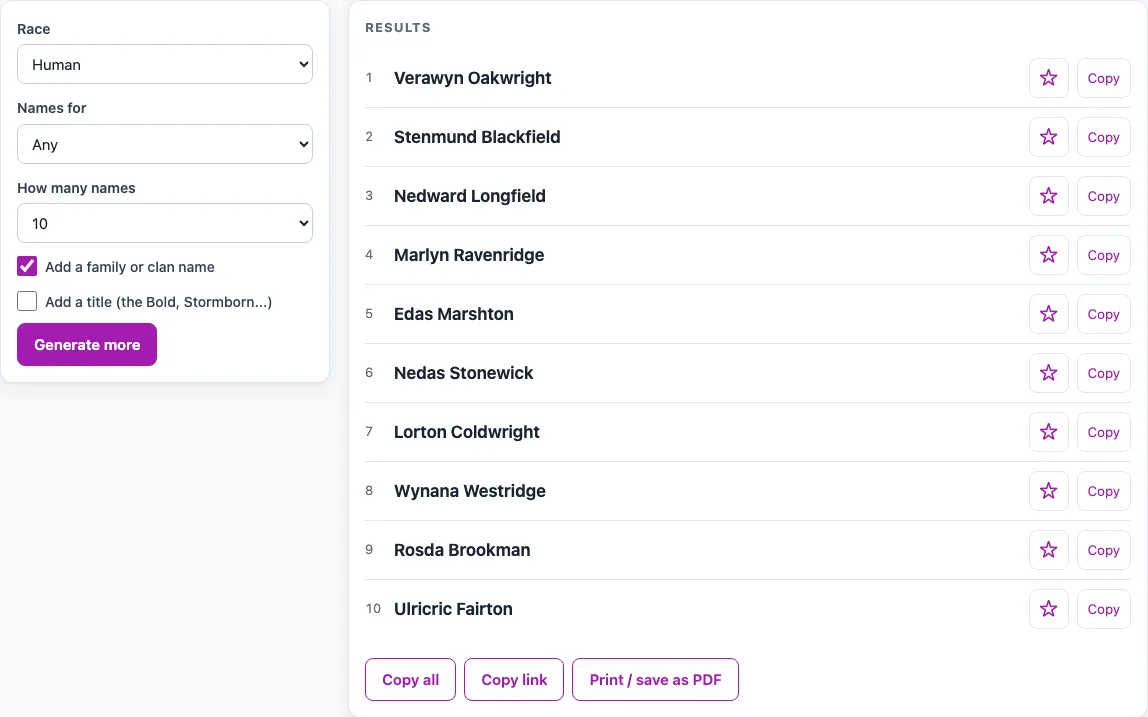
How to use the D&D name generator
- Choose a race from the Race list: Human, Elf, Dwarf, Halfling, Gnome, Half-elf, Half-orc, Orc, Tiefling with infernal names, Tiefling with virtue names or Dragonborn.
- Set Names for to Any, Masculine names or Feminine names. This choice is hidden for tiefling virtue names.
- Pick How many names: 5, 10 or 20.
- Tick Add a family or clan name if you want a surname. This option is hidden for both tiefling choices.
- Tick Add a title to give each name a short title, such as ’the Bold’, ‘Stormborn’ or ’the Wanderer’.
- Read the list. Click Generate more for a new list. Changing any option also updates the list straight away.
- Click the star beside a name to add it to My shortlist, then press Copy shortlist. To copy one name only, press Copy beside it.
Copy all copies the whole list, and Print / save as PDF prints it. Switching race keeps your other options, so you can run through all eleven races with the same settings and keep the best name from each. If a name almost works, press Generate more rather than editing it, because new lists are free and quick. Copy link saves your settings in the page address, so the same list appears when someone opens the link. My shortlist is kept only until you close the page.
How do I choose a name for a D&D character?
Start with the race and the sound you want, then test the name at the table. Say it aloud a few times, and check that you and your players can spell and pronounce it without stopping to think. Avoid giving two characters in one party names that begin with the same letter, since this makes it harder to keep track of who is speaking. A title or epithet can make a plain name memorable, so a simple first name plus ’the Bold’ often sticks better than a name alone. Finally, check that the name is not a well-known character from a book or film, because a famous name can distract players.
What do dwarf, elf, halfling and tiefling names sound like?
Each race has its own sound, and the tool follows those patterns. Dwarf names use hard syllables, and clan names join metal and craft words with beard, helm, hand or forge, as in ‘Dwalrim Ironmantle’ and ‘Thordric Goldfoot’. Elf names are soft, often ending in -wen, -iel or -ia, and their surnames come from nature words such as Silver, Moon or Dusk, joined to leaf, whisper or bough, as in ‘Ariel Duskbough’ and ‘Ara Leafwhisper’. Halfling names are cosy, with first names like ‘Rosie’ and surnames based on food or home, such as ‘Rosie Berrypocket’ and ‘Toby Pennyburrow’. Tiefling names depend on the option you pick. Infernal names are single names such as ‘Malith’, ‘Cassetta’ and ‘Xanos’, while virtue names are single words such as Mirth, Vigil, Ardor, Zeal or Grace.
Can I use generated names in my own campaign or novel?
Yes. Generated results are yours to use anywhere, including in books, games and products you sell, and no credit is needed. Names, titles and short phrases are not protected by copyright: the US Copyright Office’s Circular 33 lists names of individuals, including pseudonyms, and titles of works as not protected. The same circular notes that trademark law may apply in some circumstances, so avoid a name that is already a brand. Dungeons & Dragons and D&D are trademarks of Wizards of the Coast, and this site is not affiliated with them.
How are the names made?
The names are built from original syllable lists written for this tool, not copied from any published name table. Each race has its own sounds and its own way of forming a family name. Human names join a first syllable to an ending, and surnames join two words, such as ‘Rolan Westfield’ and ‘Kelan Woodwright’. Half-elf names mix an elf or human first name with an elf or human surname. Half-orc names use orc-style first names and, half the time, a human-style surname, as in ‘Mugdar Brookhill’. Orc names are short and harsh, with epithet-style surnames such as Ironjaw or Bonecrusher. Gnome names are playful, and about a third include a nickname in quotes, as in ‘Tinkin “Gizmo” Springspinner’. Every list has no duplicate names, ignoring capital letters, and never repeats a letter three times in a row. The same settings and seed always give the same list.
Sources
Checked 18 October 2026: US Copyright Office Circular 33, Works Not Protected by Copyright (PDF dated 26 March 2021; names, titles and short phrases are not protected by copyright, and trademark law may protect some). The name lists are original to this tool. Dungeons & Dragons and D&D are trademarks of Wizards of the Coast; this site is not affiliated with them.
Frequently asked questions
Is the D&D name generator free to use?
Yes. It is a free, browser-based tool, and you do not need an account to use it.
Does the tool send my settings or names to a server?
Nothing you type is uploaded. The tool runs in your browser, and your settings and the current seed are kept in the page address.
Why can’t I choose masculine or feminine names for tiefling virtue names?
Virtue names are single words such as Mirth or Grace, and they have no gender, so the Names for option is hidden for them.
Why don’t tiefling names have a family name?
Both tiefling options produce one-word names, so the family name option is hidden for them.
How can I get the same list again?
Use Copy link. The same settings and seed always give the same list, so opening the link shows the same names.
Can I use these names for fantasy stories that are not about D&D?
Yes. The names are not tied to one game, so you can use them as a fantasy name generator for any story or world you write.
Does the tool use names from official D&D books?
No. The tool does not use any official name table, and this site is not affiliated with Wizards of the Coast.
Related tools
- Dragon name generator: use it when your party needs a dragon with a name to match its lair or rival.
- Book title generator: use it when your fantasy story needs a title to go with its characters.
- Average novel length: use it to check how long a finished fantasy novel is likely to be.
- Writing tools for authors: use it to find other tools for planning and drafting your story.