Fantasy Town Name Generator
Pick a kind of place and a naming style to get a list of original town, village and city names for your map or story.
The fantasy town name generator creates made-up place names for villages, towns, cities, ports, fortresses and hidden refuges. Choose a kind of place and a naming style, pick how many names you want, and the list builds for you. It runs in your browser, is free to use, and needs no sign-up.
Names are built from everyday English words such as Oak, Raven and Stone, or from syllables that sound old-world or elvish. You can use them for a map, a novel or a game campaign. Each list has no duplicates. You can copy single names or the whole list, and save favourites to a shortlist while the page stays open.
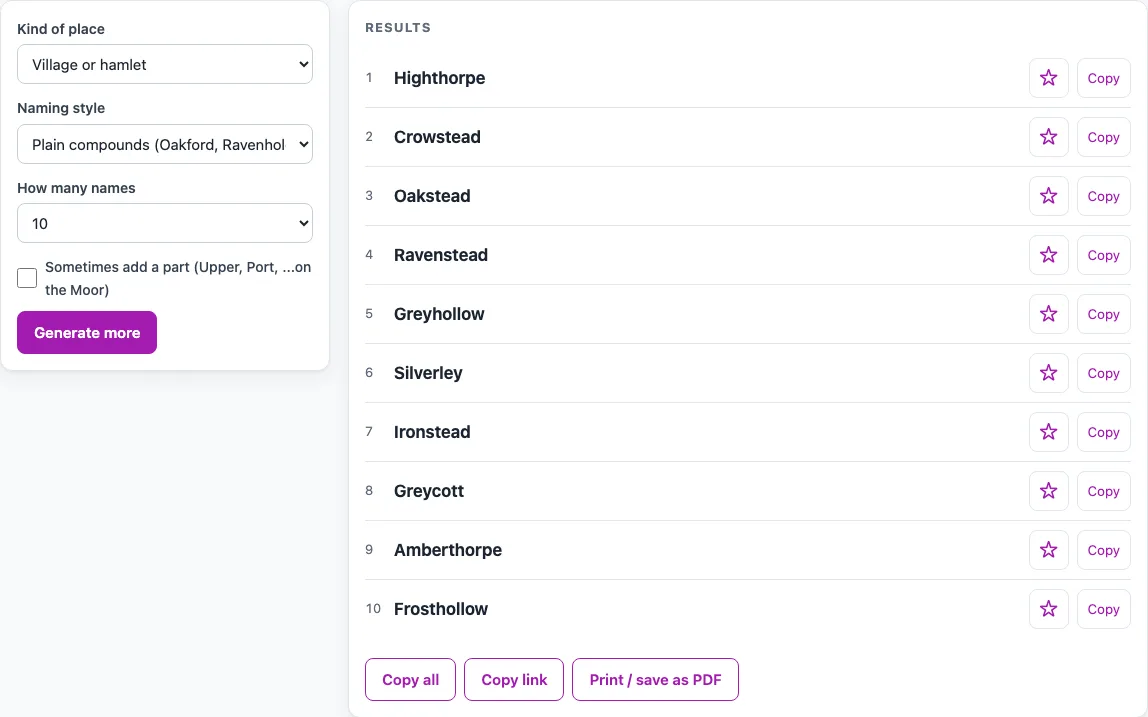
How to use the Fantasy Town Name Generator
- Choose a Kind of place: Village or hamlet, Market town, City or capital, Port or harbor, Fortress or border keep, or Hidden refuge or elven grove.
- Pick a Naming style: Plain compounds (such as Oakford or Ravenhold), Old-world syllables (such as Dunstein or Korgrad), or Elvish (such as Thalindor or Ysawen).
- Set How many names to 5, 10 or 20.
- Tick ‘Sometimes add a part’ if you want a prefix such as Upper, Old or East. For most plain-style places, this can also add a tail such as ‘on the Moor’ or ‘under the Hill’.
- Read the list. It refreshes as soon as you change an option, so you can try different settings freely.
- Click ‘Generate more’ to make a new list with the same settings.
- Click ‘Copy’ beside any name, or ‘Copy all’ to copy the whole list.
Click the star beside a name to add it to My shortlist, which appears under the results. The shortlist is kept only until you close the page, and ‘Copy shortlist’ copies everything on it. ‘Copy link’ gives you a page address that reproduces the same list, which is useful for sharing with a co-writer or game group. ‘Print / save as PDF’ prints the current list.
How do I name a fantasy town?
A good fantasy town name usually pairs a first word that hints at the land with an ending that tells the reader what kind of place it is. Start with a word such as Oak, Raven, Stone, Iron, Mist, Frost, Silver or Amber, then choose an ending that fits the place.
The ending changes with the place. Villages end in -ford, -wick, -ham, -stead, -by, -thorpe, -brook, -field or -dale, so Oak becomes Oakford. Market towns use -bury, -ton, -gate, -bridge, -well, -mere or -worth, as in Ashgate or Thornbury. Cities use -crown, -spire, -hold, -haven, -keep, -reach, -throne or -watch, as in Silverthrone. Ports end in -harbor, -quay, -mouth, -wharf, -bay, -sound, -cove or -point, as in Elmsound. Fortresses use -keep, -hold, -guard, -stand, -rock, -tower, -ward or -crag, as in Ravenstand.
Old-world and elvish names work differently. They join a syllable start to an ending suited to the place, so the sound carries the setting rather than an English word. Hidden refuges in plain style are always two words, such as Silent Hollow or Moonlit Haven.
What makes a fantasy village name sound believable?
A believable village name is short, uses words a reader already knows, and ends in a suffix that English village names often use. Two parts are usually enough. Claythorpe, Marshstead and Ironley all follow that pattern: a plain noun followed by a village ending.
Keep the first word concrete. Clay, marsh and iron describe land or work that a reader can picture. Avoid stacking two long descriptive words, because they sound more like a title than a place. Say the name aloud, too. If it trips over your tongue, a reader will stumble on it as well.
Use the extra-part option sparingly. A prefix such as Old or Little can make a village feel lived in, as in Old Ironley. A tail such as ‘under the Hill’ suits a village on a map, but it can make a short name feel crowded.
Frequently asked questions
Can I use these town names in my novel or game map?
Yes. Generated results can be used anywhere, including in books, games and products you sell, and no credit is needed. Before you publish, search for each name you plan to use, because some everyday words can match a real place or existing work by chance.
What are some names for a hidden elven village?
Choose Hidden refuge or elven grove as the kind of place, then compare the naming styles. Plain style gives two-word names such as Silent Hollow, Veiled Dell or Whispering Refuge. Elvish style gives names with a more flowing sound, such as Oranari, Ysalindor or Naerael, so try both and keep the ones that fit your setting.
Do the generated names match real places?
They can. The names use everyday English words, so some may match a real town, village or person by chance. Search any name before you use it in something you publish or sell.
Will I get the same list again if I come back later?
Only through the link. Each visit to the page starts with a new seed, and the same settings and seed give the same list, which is what the ‘Copy link’ address relies on. Open that link to see the exact list again.
Are there any duplicate names in a list?
No. Every list is checked so that no name appears twice, ignoring capital letters.
Does the tool keep my names or upload them?
Everything runs in your browser and nothing is uploaded. Names on My shortlist are kept only until you close the page.
Related tools
- DnD Name Generator: Use it when you need names for characters, not places, for a tabletop campaign.
- Dragon Name Generator: Use it when your map or story needs a dragon to live near your new town.
- Book Title Generator: Use it when you have the setting and need a title for the story it belongs to.
- Average Novel Length: Use it when you are planning how long your world-building and story should run.