Reading Time Calculator
Paste your text or enter a word count or book length to get the reading time, along with word, character and sentence counts. Silent and aloud paces come from a published study.
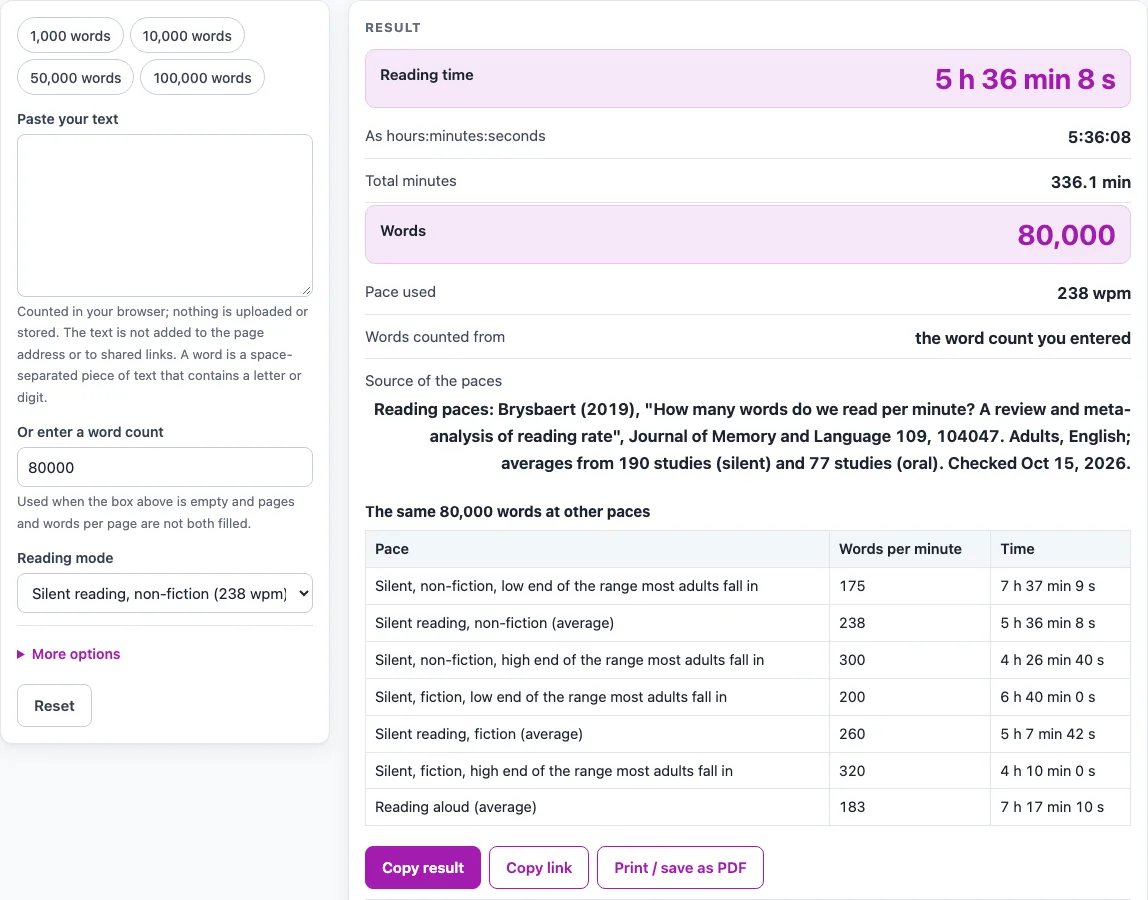
How to use the Reading Time Calculator
- Choose how to give the length. Pasted text is used first: if you type or paste into “Paste your text”, the tool counts it and ignores the other length fields.
- Otherwise, enter a number in “Or enter a word count”. The default is 80,000 words, and the presets set it to 1,000, 10,000, 50,000 or 100,000 words.
- For a book, open the advanced options and fill in “Pages in the book” and “Words per page” together. Type your own words-per-page figure, because the tool does not assume a standard value. When both are filled, they are used instead of the word count.
- Under “Reading mode”, choose “Silent reading, non-fiction (238 wpm)”, “Silent reading, fiction (260 wpm)”, “Reading aloud (183 wpm)” or “My own speed”.
- If you chose “My own speed”, type your pace in “Your reading speed (words per minute)”. A pace below 50 wpm or above 1000 wpm shows a warning.
- Read the results: “Reading time” as h min s, the clock form, “Total minutes”, “Words”, “Pace used” and “Words counted from”. With pasted text you also see characters with and without spaces and the sentence count.
- Check “Source of the paces”, which gives the date the paces were checked: 15 Oct 2026.
Your pasted text is not added to the page address or to a copied link.
How is reading time calculated?
Reading time is the number of words divided by the reading pace in words per minute (wpm), then multiplied by 60 to give seconds. The result is rounded to the nearest whole second and shown as h min s and as h:mm:ss, with total minutes beside it.
In short: reading time = words ÷ wpm × 60 seconds.
For example, 80,000 words at 238 wpm gives 336.13 minutes, or 5 h 36 min 8 s (5:36:08). The same words at 260 wpm give 5:07:42.
A word, for this tool, is a whitespace-separated piece of text that contains at least one letter or digit. A lone dash or ampersand is not counted. Sentences are counted when you paste text: a run of ., !, ? or … followed by a space or the end of the text counts as one sentence, with one more added if the text has no final mark. A number such as 3.5 is not split, but abbreviations such as “etc.” are, which is a known limit of the rule.
The reading paces come from Brysbaert (2019): silent non-fiction 238 wpm, silent fiction 260 wpm, and reading aloud 183 wpm. These are averages for adults reading English. The table on the page shows the same word count at seven sourced paces: non-fiction at 175, 238 and 300 wpm, fiction at 200, 260 and 320 wpm (the ranges the paper says most adults fall in), and 183 wpm aloud.
How long does it take to read a book?
It depends on the word count and the pace you read at. The default is 80,000 words, which is a starting setting, not a claim about how long a typical book is.
Page-based entries work the same way. For example, 320 pages at 275 words per page is 88,000 words. At the fiction pace of 260 wpm, that gives 338.46 minutes, or 5 h 38 min 28 s. Your own page count and words per page may be different, so use the figures from your own text.
Sources (checked 15 October 2026): doi.org
Worked examples
| Input | Result |
|---|---|
| 80,000 words, Silent reading, non-fiction (238 wpm) | 5 h 36 min 8 s to read |
| 80,000 words, Silent reading, fiction (260 wpm) | 5 h 7 min 42 s to read |
| 1,500 words, Reading aloud (183 wpm) | 8 min 12 s to read |
| 5,000 words, My own speed | 16 min 40 s to read |
| 88,000 words, Silent reading, fiction (260 wpm) | 5 h 38 min 28 s to read |
Calculated by the tool above; open it with the same values to see each step.
Frequently asked questions
Why does the calculator call the result an estimate?
Reading speed differs from person to person and from one kind of text to another. The paces used here are averages for adults reading English, so your own time may be shorter or longer.
Does the tool upload my pasted text?
No. Pasted text is counted in your browser and is never uploaded. The text is also left out of the page address, so it does not appear in your browser history or a copied link.
What is the difference between the reading modes?
“Silent non-fiction” uses 238 wpm, “silent fiction” uses 260 wpm, and “reading aloud” uses 183 wpm. Choose “My own speed” if you know your pace and want to type it into the custom words-per-minute field.
What happens if I enter a very slow or very fast custom pace?
A custom pace below 50 wpm is flagged as very slow. A pace above 1000 wpm is flagged because the paper’s source states that reading faster than that is not possible without severe loss of understanding.
How are sentences counted?
A sentence ends at a run of ., !, ? or … followed by a space or the end of the text, with one more added if the text has no final mark. Numbers such as 3.5 are not split, but abbreviations such as “etc.” are, so the count can be a little high in text that uses many abbreviations.
Where do the reading paces come from?
They come from Brysbaert (2019). The source line on the page gives the date the paces were checked, which is 15 Oct 2026.
Related tools
- Words per Minute Calculator: use it when you know a word count and time and want the pace in words per minute.
- Reading Speed Test: use it when you want to find out your own reading pace before you enter a custom speed.
- Audiobook Length Calculator: use it when you want to estimate how long a spoken version of a text will run.
- Audiobook Speed Calculator: use it when you want to see how a playback speed changes the length of an audiobook.
- Speech Time Calculator: use it when you are timing a spoken talk or speech rather than silent reading.