Villain Name Generator
Pick a kind of villain to get a list of original villain names, with an optional rank and epithet.
The Villain Name Generator makes lists of villain names for dark lords, sorcerers, vampires, pirate captains, crime bosses and space tyrants. You pick a kind of villain, choose masculine, feminine or any-gender names, and the tool builds a list for you. It is free and runs in your browser. Nothing is uploaded and you do not need to sign up.
Each name is built from a first part and an ending that suits its kind. Some names also get an epithet, such as “the Hollow,” or a rank, such as Lord or Countess. Treat the list as a starting point for a novel, tabletop campaign, video game or short story, and adjust names until they fit your character.
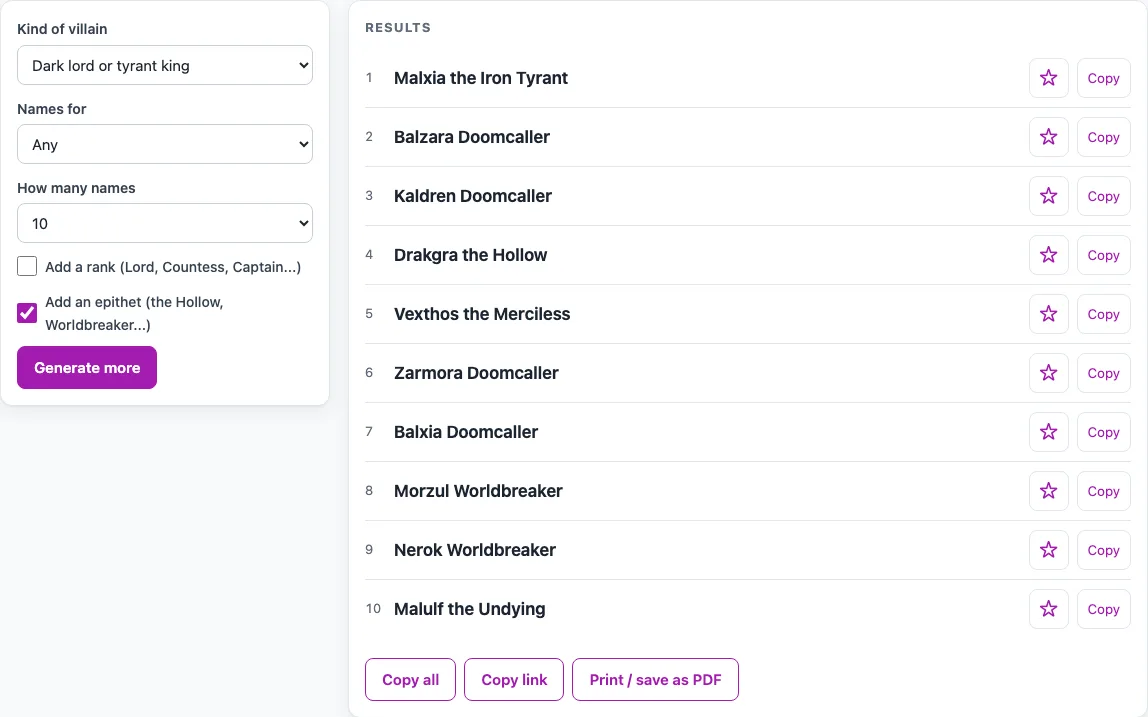
How to use the Villain Name Generator
- Open the villain type menu and choose a kind: Dark lord or tyrant king, Sorcerer or witch, Vampire, Pirate captain, Crime boss or Space tyrant.
- Set Names for to Any, Masculine names or Feminine names. With Any, each name picks masculine or feminine on its own.
- Set How many names to 5, 10 or 20.
- Check the extras. Add an epithet is ticked by default and adds a title after the name. Add a rank is not ticked by default. Tick it to put a rank such as Lord, Countess or Captain before the name.
- Read the list. It refreshes as soon as you change an option, so you can try different settings without pressing a button.
- Press Generate more to get a new list with the same settings.
- Click Copy beside one name, or Copy all to copy the whole list.
Click the star beside a name to add it to My shortlist under the results. Use Copy shortlist to copy your picks together. The shortlist is kept only until you close the page. Copy link copies a page address that brings back the same list, which is useful for sharing with a co-writer or group. Print / save as PDF prints the current list.
How do I come up with a good villain name?
A good villain name is short, easy to say and suited to the kind of villain it belongs to. Strong names usually pair a simple, memorable sound with a detail that hints at the character’s power, history or method.
The tool follows the same idea by giving each kind of villain its own sound. Dark lords get hard endings such as -gath, -zul or -kor. Crime bosses get Italian-sounding endings such as -etti or -ino. Pirates get compound names such as Black + beard. An optional epithet or rank is then added on top.
You can apply the same approach by hand. Say each name aloud and check whether it sounds clear in a sentence. Make sure your villain’s name does not start with the same letter or sound as your hero’s, so readers can tell them apart. Keep names short enough to fit in dialogue, since a long name repeated many times can slow a scene down.
Should a villain name sound dark?
The answer depends on the villain and on the story. You can test it with this tool: generate the same kind of villain with the epithet on and off, and see which version fits the scene you have in mind.
Not always. A dark sound helps readers or players recognise a villain quickly, and hard consonants such as k, g and z are common in names meant to feel menacing. These work well for a tyrant king or space tyrant whose power is obvious.
A softer or ordinary name can be more unsettling, especially for a villain who hides behind politeness. A countess or a crime boss with a warm nickname can be more frightening than a name full of harsh sounds, because the contrast makes the character feel controlled. Match the name to the role and the story’s tone, and avoid piling on dark words just to sound threatening.
Frequently asked questions
What are some names for a dark lord or sorcerer?
Sample names from the tool include “Skaroth the Black Hand” and “Drakrok the Hollow” for dark lords, and “Veroth of the Nine Seals” and “Nyrius Hexweaver” for sorcerers. Choose the Dark lord or Sorcerer kind to generate a fresh list in that style.
Can I use these villain names in my story or game?
Yes. Generated results can be used anywhere, including in books, games and products you sell, and no credit is needed. Some generated names may match a real person, place or existing work by chance, so search for a name before using it commercially.
Why does my list change when I change an option?
The list refreshes as soon as you change any setting, so it always matches your current choices. The same settings and seed give the same list, which is what makes the Copy link feature work. Each visit to the page starts with a new seed.
Can the list contain the same name twice?
No. Every list is checked for duplicates, ignoring capital letters, so each name appears only once.
Why is there a title in front of the name?
That is the rank, shown before the name. It appears only when you tick Add a rank, and the rank options depend on the gender you chose, such as Lord or Lady. An epithet, which comes after the name, is added by default and can be unticked.
Is my shortlist saved after I close the page?
No. The shortlist stays under the results only until you close the page. Use Copy shortlist or Print / save as PDF before you leave if you want to keep your picks.
Related tools
- DnD Name Generator: Use it when you need names for player characters, NPCs or towns in a Dungeons & Dragons campaign.
- Dragon Name Generator: Use it when your villain has a dragon, or when you need a name for a fearsome creature.
- Book Title Generator: Use it when you have a villain and need a title for the book they appear in.
- Average Novel Length: Use it when you are planning how long your story should be and how many characters it can support.